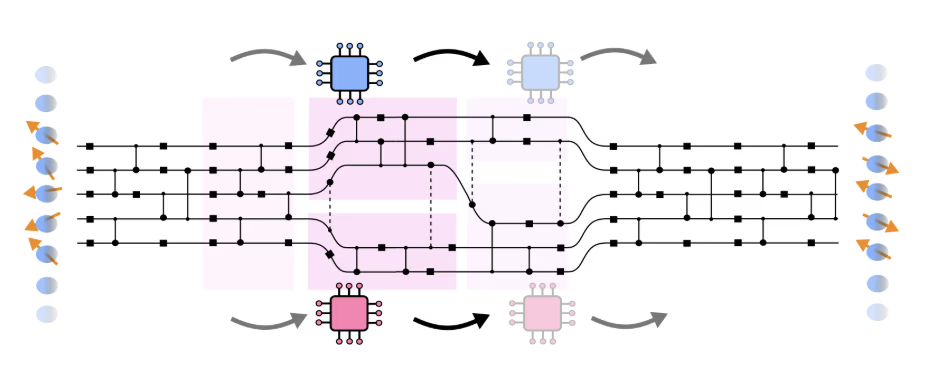
How AgenticOS coordinates specialist scientific agents to build, test, and trace a quantum experiment
Read the paper accepted at NeurIPS 2026 workshop.
Proton transfer is one of the most fundamental processes in chemistry, and it underlies acid-base reactions. The Zundel cation, H₅O₂⁺, is a compact model of it [1]: two water molecules share one extra proton. The proton can sit close to either water, like a ball resting in one of two valleys, and moving it from one valley to the other means pushing it over the hill between them. The height of that hill, the energy barrier, controls how fast the transfer happens.
We gave the same task to ten standalone AI runs and to AgenticOS. Every run produced working code, but they did not perform the same experiment. Four runs violated explicit instruction to keep all the electrons. Others changed the molecular geometry or followed a different proton-transfer path.
AgenticOS fixed the scientific setup before implementation and tested the code against it. The workflow reproduced the expected two-valley curve. Its quantum method, sample-based quantum diagonalization (SQD) [2], gave a barrier of 554.8 meV, compared with the 574.3 meV FCI reference, a difference of 3.4% for the model studied.
The Input
Every run received the same task: calculate how the energy changes as a proton moves between two water molecules.
The oxygen atoms had to remain 2.9 Å apart, all 20 electrons had to be included, and each method had to be compared with the same FCI reference.
How Does AgenticOS Prevent Mistakes?

AgenticOS divided the work into reviewed steps. Each step saved its inputs, results, tests, and decisions before the next step began.
When a check failed, the work returned to the step that caused the problem. A human researcher reviewed the important decisions.
AgenticOS fixed the number of electrons, the shape of the molecule, the proton's path, and the comparison method before the calculation began. It checked these details again as the work progressed.
Three checks kept the experiment on track.
- Fix the setup: The electron count, molecular geometry, and target quantity were written into the configuration and tests.
- Check the tests: Critic agents looked for tests that passed without checking the right scientific property.
- Keep a record: AgenticOS saved the structures, settings, samples, test results, and review decisions.
What Went Wrong in the Standalone Runs?
The ten standalone runs produced different energy curves because they did not preserve the same experiment. Some left out required electrons, while others changed the geometry or proton path.

- Reference: The dashed curve uses the fixed 12-point AgenticOS protocol with 15 orbitals, 20 electrons, no frozen core, and a 2.9 Å O-O distance.
- Standalone runs: The curves come from different experimental setups, even though every run received the same task.
A convincing curve is useful only when the experiment behind it is clear and consistent. AgenticOS was the only workflow that kept the agreed setup from start to finish.
Some runs left out electrons. Others moved the atoms differently. They produced curves, but they were not running the same experiment.
What Does the AgenticOS Run Show?
All five methods calculated the same proton-transfer curve. They differed in how they treated the motion of the electrons. FCI was the reference for this model.
- PBE: 83 meV. Its approximate treatment produced a barrier that was too low.
- Hartree-Fock: 785 meV. It used one electronic pattern and missed part of how the electrons move together.
- CCSD: 606 meV. It included more electron interactions and came closer to FCI.
- FCI: 574.3 meV. It provided the reference answer for the chosen model.
- Quantum method (SQD): 554.8 meV. It used quantum sampling followed by a classical calculation and gave the closest result to FCI.

SQD put the height of the energy hill at 554.8 meV. The reference result was 574.3 meV, a difference of 3.4%.
The methods differ because each captures electron motion with a different level of detail. SQD uses a quantum circuit to sample the electron configurations most likely to matter. A classical solver then calculates the energy from that smaller set. The full model contains more than nine million possible electron configurations. SQD focused on a smaller set and produced the closest barrier to the FCI reference.
Conclusion and Outlook
Reliable computational chemistry depends on keeping the scientific question consistent from setup through analysis. In this study, the standalone runs produced working code, but several changed the electron count, molecular geometry, or proton-transfer path. Their results therefore could not be compared directly.
AgenticOS maintained one shared experimental setup across the calculation. It also kept the inputs, tests, intermediate results, and review decisions available for inspection. For research teams, the value reaches beyond one calculation. AgenticOS can coordinate work that crosses scientific literature, molecular modeling, software development, and validation while keeping important assumptions visible. Researchers remain responsible for the scientific choices and interpretation.
We hope this example encourages other scientists to bring their own difficult, multi-step research questions to AgenticOS. The platform can help organize the investigation, test competing approaches, uncover hidden inconsistencies, and produce results that are easier to review and build upon.
Footnotes
[1] M. Schröder, F. Gatti, D. Lauvergnat, H.-D. Meyer, and O. Vendrell. The coupling of the hydrated proton to its first solvation shell. Nature Communications 13, 6170 (2022). https://doi.org/10.1038/s41467-022-33650-w
[2] J. Robledo-Moreno et al. Chemistry beyond the scale of exact diagonalization on a quantum-centric supercomputer. Science Advances 11(25), 2025. https://doi.org/10.1126/sciadv.adu9991